AI Architect

I build AI systems that survivecontact with reality.

I'm Anudeep Sri Bathina, an AI Architect leading agentic AI platforms, multimodal RAG, and governed data systems, from architecture through production operations.

11+ years

AI, data & platform engineering

16 engineers

Architecture + delivery leadership

1,500+

Developers served by public GenAI

01 / Experience

From data engineering delivery to AI systems ownership.

Data engineeringML deliveryAI systems

AI Architect

Current
AT&T

Agentic AI · multimodal RAG · governed lakehouse · observability

Owns architecture and delivery for AT&T’s $4M competitive-intelligence platform, leading a 16-person team across agentic AI, multimodal RAG, governed data, and production operations for pricing, strategy, and sales teams.

2026–Present

Lead AI Engineer

AT&T

Public GenAI · RAG · MCP · developer platform

Launched AT&T’s first public-facing GenAI product for 1,500+ API developers. The LangGraph and RAG platform cut integration time 80%, resolved 99% of queries at sub-2-second latency, sustained 99% uptime, and earned the RISE Award.

2024–2026

Technical Lead

Capgemini

Azure ML platform · team leadership · MLOps

Led an 11-person team delivering a Databricks and Spark ranking platform for Unilever UK; raised Precision@10 from 62% to 85%, reduced stockouts 18%, and cut pipeline runtime 40%.

2019–2021

Big Data & ML Engineer

GainInsights Solutions

Distributed ML · product engineering · containers

Independently built and scaled Strait, a proprietary Big Data and ML platform using PySpark, Dask, predictive models, and containerized delivery.

2019–2019

Cloud Data Associate

Cognizant

Cloud migration · data engineering · analytics

Migrated 300GB of airline data to Azure SQL, improved SLA compliance 18%, reduced manual pipeline effort 60%, and tripled query performance for 200GB of healthcare data.

2015–2019

Selected production outcomes

Proof from systems operating at scale.

AT&T · Lead AI Engineer
1,500+API developers servedAT&T’s first public-facing GenAI product
80%Faster API integrationReduced a 2.5-hour integration bottleneck
99%Query resolutionGrounded answers with 99% platform uptime
<2sAnswer latencyProduction RAG and live API execution
02 / Focused expertise

I architect AI agents and the platforms that run them.

From orchestration and tool boundaries to evaluation, observability, and production delivery. Each capability is tied to working evidence.

01

AI agents & orchestration

LangGraph- and Fleet-based agents with explicit state, tool boundaries, deep research, and human review.

  • LangGraph
  • LangSmith Fleet
  • MCP
  • H2O Super Agents
Evidence: ShiftIQ + ClinIQ
02

Evaluation, observability & safety

Agent tracing, groundedness checks, responsible-AI guardrails, privacy boundaries, and explicit failure behavior.

  • Arize
  • LangSmith
  • Responsible AI
  • OWASP LLM
Evidence: ClinIQ + field notes
03

AI platform architecture

Production service boundaries, model routing, typed APIs, identity, containers, and scalable delivery patterns.

  • Azure AI Foundry
  • AKS
  • FastAPI
  • Entra ID
Evidence: AT&T + ShiftIQ
04

Data & lakehouse architecture

Governed lakehouses, distributed processing, data quality, and compliant data products that feed production AI.

  • Databricks
  • Snowflake
  • Apache Iceberg
  • PySpark
Evidence: AT&T + Capgemini

Selected credentials

  • AWS Generative AI Partner Training · 2024
  • Databricks LLM Fine-Tuning & Production · 2024
  • Microsoft Fabric Analytics Engineer · 2024
  • Microsoft Responsible AI Practices · 2024
  • Google Generative AI Learning Path · 2023
03 / Beyond delivery

Research, guest lectures, and mentorship.

Research sharpens the evaluation practice. Teaching makes AI practical, while career mentorship helps people move forward.

500+AI teaching hoursIncluding 306 hours at UT Austin
200+Session attendeesAcross hands-on AI programs
1,000+Learners reachedThrough teaching and community
70+Career mentorship sessionsAcross Topmate and ADPList

Education

M.S. Computer Science

University of Massachusetts Dartmouth · 2023

B.Tech Electrical & Electronics Engineering

VIT University · 2015

Recognition

RISE Award

AT&T · production GenAI delivery

Extra Mile

Capgemini · data and ML delivery

4.76 / 5

UT Austin · learner rating

Mentor testimonials

What learners say after the conversation.

View ADPList profile
“Anudeep is incredibly insightful, listening carefully and offering technical yet straightforward comments that are truly beneficial.”

Michael

Freelance Developer · ADPList

“Extremely insightful and valuable discussion. Anudeep's depth of knowledge in Data and AI is evident, and his willingness to openly share his expertise is commendable.”

Shashank H.V.

Student, UMass Dartmouth · ADPList

“His tailored advice on skills, job applications, and interviews was practical and insightful, leaving me confident and motivated.”

Baran Khazaee

MSc CS, UC Davis · ADPList

“His strategic guidance and ability to simplify complex AI and career paths into clear, actionable steps were incredibly helpful.”

Nelisa Sebastian

Data Analyst, Northeastern · ADPList

“An exceptional session, making complex Agentic AI concepts easy to understand. His motivating approach inspired me to take bold steps.”

Mide Sowunmi

UX/UI Designer, Comcast · ADPList

04 / Selected work

Systems you can inspect, not just claims you can read.

Three complementary examples show how I frame boundaries, make consequential decisions, and leave evidence behind for the next reviewer.

AI agents / developer platform

ShiftIQ

Open-source agent platform

Code migrations require coordinated analysis, planning, and validation without letting autonomous changes outrun human review.

Fleet agentsAnalyze + plan
Dry runReview proposed diff
ApplyCheckpoint + rollback
Fleet coordinates bounded analysis and migration agents across CLI, API, MCP, and UI surfaces. Target code is analyzed without import or execution.

My contribution

Architected and built a Fleet-powered agent platform for codebase analysis and migrations, with CLI, API, MCP surfaces, checkpoints, and sensitive-pattern scanning.

Use case

Engineering teams assessing and applying code migrations.

Evidence-backed outcome

The repository uses Fleet to coordinate the bounded workflow across CLI, FastAPI, MCP tools, and UI surfaces. Generated migrations still require human review.

Inspect constraints and decision

Constraints

  • No target-code execution
  • Review before apply
  • Redacted scan findings
  • Recoverable changes

Decision / consequence

Use Fleet to coordinate bounded agents while keeping dry-run as the default and requiring an explicit apply step backed by a rollback checkpoint.

Agent handoffs and human review add latency, but make each proposed change traceable, inspectable, and recoverable.

Review repository

Computer vision / evaluation

Groundfish recognition

Graduate research

Recognizing groundfish across image collections is difficult when underwater datasets are limited and visually inconsistent.

01Underwater frameCross-database input
02YOLOv8Locate the fish
03ResNet-50Classify the crop
Reported result94.10% mAPThesis evaluation workload
The research pipeline takes an underwater frame, localizes the fish with YOLOv8, and classifies the crop with ResNet-50.

My contribution

Graduate researcher and thesis author; developed and evaluated a cross-database recognition pipeline.

Use case

Fisheries and computer-vision researchers exploring automated species recognition.

Evidence-backed outcome

The UMass Dartmouth research reports 94.10% mAP and 92.14% classification accuracy on its evaluated workload. These are thesis results, not production benchmarks.

Inspect constraints and decision

Constraints

  • Limited underwater data
  • Cross-database variation
  • Detection + classification
  • Research-only evaluation

Decision / consequence

Separate localization with YOLOv8 from classification with ResNet-50.

Two stages can be evaluated independently, but errors from detection can propagate into classification.

Read the thesis
05 / Engineering approach

Make the invisible parts reviewable.

Model choice is one decision. Scope, evaluation, failure behavior, and operating boundaries determine whether the whole system can be trusted.

01

Architecture

Boundaries before breadth

Scope retrieval, identity, and data movement before adding more model capability.

Evidence: ClinIQ

02

Evaluation

Failure paths are product paths

Test unsupported questions, access rules, masking, and groundedness, not only happy-path answers.

Evidence: ClinIQ evaluation pack

03

Delivery

Make change inspectable

Use bounded Fleet agents, dry-runs, checkpoints, and human review when automation can alter code or policy.

Evidence: ShiftIQ

04

Observability

Operate what you ship

Track latency, cost, answer quality, and agent behavior as production signals, not afterthoughts.

Evidence: AT&T + InferIQ

System walkthrough · ClinIQ

One request, four guarded stages.

Verified repo

01 / Ask

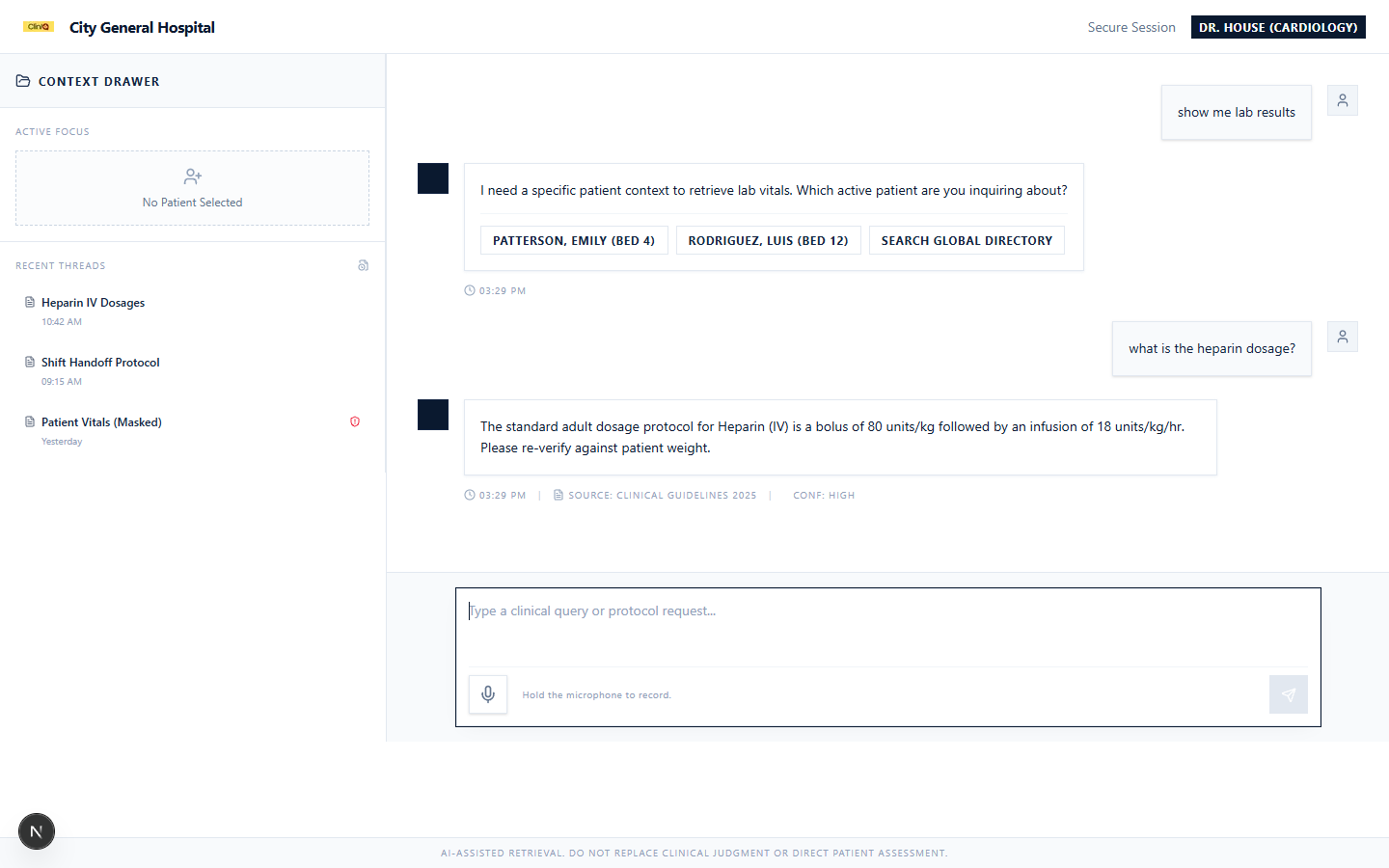
A staff member asks a policy question. The interface can request clarification before retrieval when patient or department context is ambiguous.

Decision: separate department indexes make the access boundary explicit, at the cost of more index management.

A ClinIQ policy request is clarified, checked against role and department scope, retrieved from an allowed knowledge index, graded for relevance, generated with citations, and verified for groundedness before the answer is returned.
06 / Contact

Bring me the AI problem that has to hold up in production.